
| Malabar Bladdernut |

|
 |

|


 |
 ative ative |
 |
 |
 |
Photo: |
Botanical name: Turpinia malabarica Family: Staphyleaceae (Bladdernut family)
Synonyms: Turpinia nepalensis var. montana
Synonyms: Turpinia nepalensis var. montana
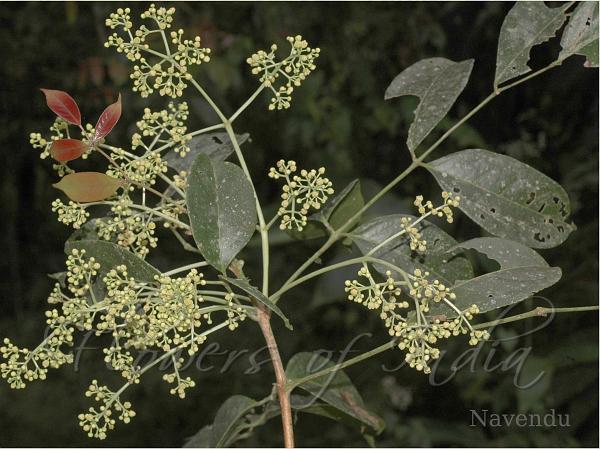
Malabar Bladdernut is a trees up to 20 m tall, bole
buttressed, bark greyish-brown. Leaves are compound, opposite; axis
19-25 cm long, stout, swollen at base, hairless. Leaflets are 3-7,
opposite, stipellate; leaflet-stalk 0.2-2 cm, slender, grooved above;
blade 5-12 x 1.5-5 cm, elliptic, elliptic-obovate, elliptic-ovate or
elliptic-lanceshaped, base pointed or wedge-shaped, tip tapering or
bluntly tapering, margin sawtoothed, hairless, leathery, lateral nerves
4-7 pairs, pinnate, slender, prominent, intercostae netveined,
prominent. Flowers are bisexual, yellowish-white, 8-10 mm across, borne
in leaf-axils and at branch-ends, in panicles with opposite branches.
Sepals are 5, 3 mm long, ovate, slightly fused at base, blunt, fringed
with hairs; petals 5; stamens 5; ovary stalkless, superior, 3 lobed,
3-celled. Fruit is a woody berry, up to 2.5 cm across, nearly spherical,
1-3 pointed, but not lobed, hairless; seeds flattened into one plane.
Malabar Bladdernut is found in Western Ghats and Sri Lanka.
| Identification credit: Navendu Pāgé, Giby Kuriakose | Photographed in Karnataka. |
• Is this flower misidentified? If yes,